

March 18, 2026
Meghan O'Toole
Learning by doing in Schultz’s lab drives student discovery and opportunity
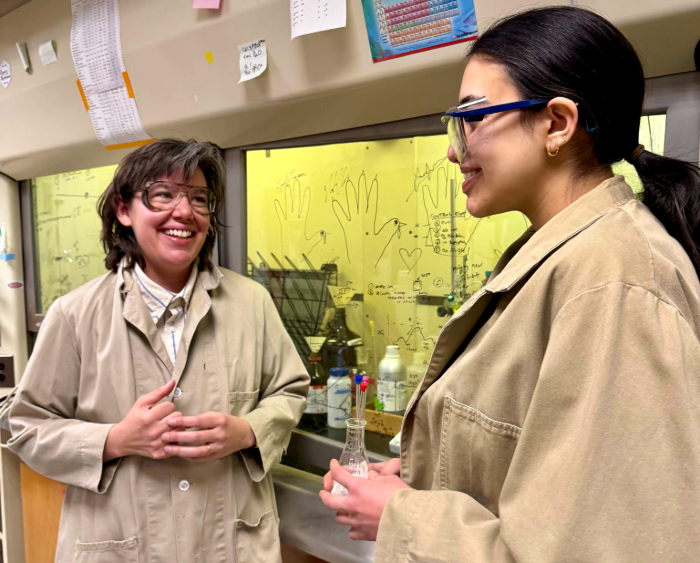 Associate Professor of Chemistry Erica Schultz and Mariam Beshara '26
Shortly after graduating—or even before—six Lake Forest College students have already done what many scientists spend years working toward: publishing peer-reviewed research and turning that experience into career momentum.
Working in Associate Professor of Chemistry Erica Schultz’s research lab, the student-led team helped design and carried out a research project that not only resulted in a publication in the American Chemical Society’s open-access journal ACS Omega but also helped launch their careers in the chemical industry. Today, the co-authors who have completed their bachelor’s degrees are working in professional laboratories, applying the same techniques and problem-solving skills they developed as undergraduates.

Jacob Levin ’20
Schultz’s research focuses on designing greener methods to make new chemical compounds, such as pharmaceuticals, with less chemical waste in addition to developing methods to aid in the removal of environmentally persistent chemicals that pollute the water supply.
“Pd-Catalyzed Hydroxylation of Aryl Halides under Air and in Eco-Friendly Solvent” arose from the group’s attempt to design a reaction to degrade environmental pollutants: “While attempting to design a reaction that to degrade environmental pollutants in the presence of living bacteria, like those found in wastewater treatment facilities, we accidently discovered a more environmentally and economical way to create phenols, a type of molecule often found in pharmaceutical compounds,” Schultz explained.

The student co-authors listed alongside Schultz in the publication are Jacob Levin ’20, Alana Garcevic ’24, Diana Rosiles-Dueñas ’24, Yousif Saleh ’24, Mariam Beshara ’26, and Gwendolyn Jones ’26.
Research opportunities are crucial for graduates seeking careers directly after finishing their degrees as well as for those who are pursuing graduate studies. Garcevic, who now works at AbbVie as a contractor in Analytical Research and Development, understands the importance of research opportunities firsthand.
“My experience working in Dr. Schultz’s lab is the main reason I was able to get this position at AbbVie,” Garcevic shared. “I was able to actually familiarize myself with analytical instrumentation, like HPLC (high-performance liquid chromatography), which lab classes don't really allow the time for. I now use the same instrument many times a week, so I’m grateful for the exposure I had in undergrad.”
Rosiles-Dueñas was able to secure a position as a Drug Product QC Lab Analyst at AbbVie before graduation.
“The research program helped me acquire further experience using chemical knowledge and troubleshooting which is needed to go into industrial chemistry as well,” Rosiles-Dueñas said. “Most of my time in the research lab was spent in the summer working eight hours a day, sometimes even more, which helped me get into the mindset of working a 9-5 in a laboratory.”

Alana Garcevic ’24, Erica Schultz, and Diana Rosiles-Dueñas ’24
The Lake Forest College research group was given a shout out for the special issue, “Undergraduate Research as the Stimulus for Scientific Progress in the USA.” The issue’s editorial stated that liberal arts colleges are a “locus not only for outstanding research in core chemistry topics but also for pedagogical innovation. The dual excellence found at PUIs, where faculty combine scientific expertise with exceptional pedagogical skills to mentor and develop future scientists.”
“During research students take responsibility for structuring their day and maintaining detailed observations and data, so when a problem arises, they don’t panic but can break it down into smaller parts and take steps to address each one,” Schultz said. “This benefits the student whether they end up in a career in chemistry or move into other fields like medicine because when they move onto their next role, they have the confidence and experience to excel.”

Mariam Beshara '26 conducting Nuclear Magnetic Resonance (NMR) spectroscopy
Of Schultz’s six undergraduate co-authors, two were still students at the time of publication, and the other four are enjoying careers in the chemical industry in Lake County: three work at AbbVie, and one works at Anton-Paar Instruments.
“Their success in a testament to coming to our liberal arts college to study chemistry,” Schultz said.